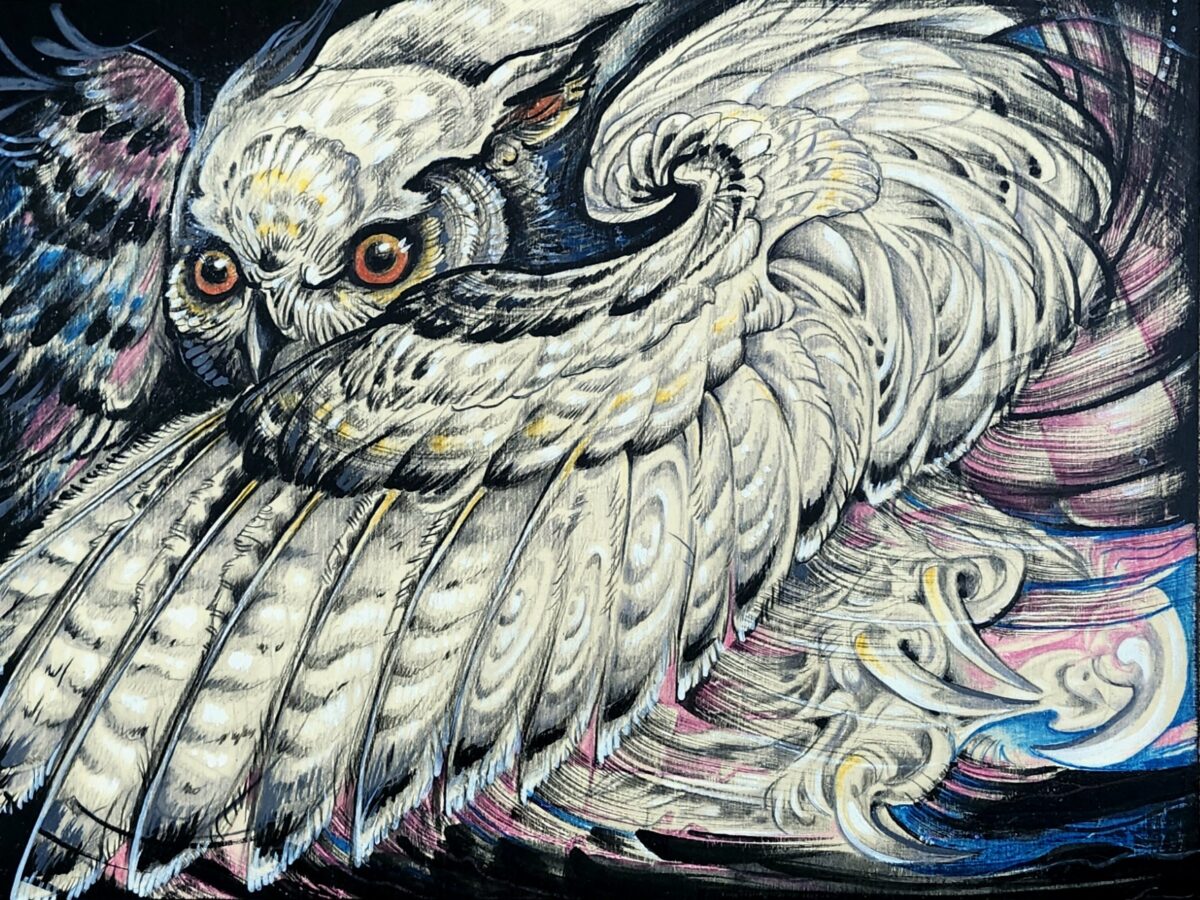
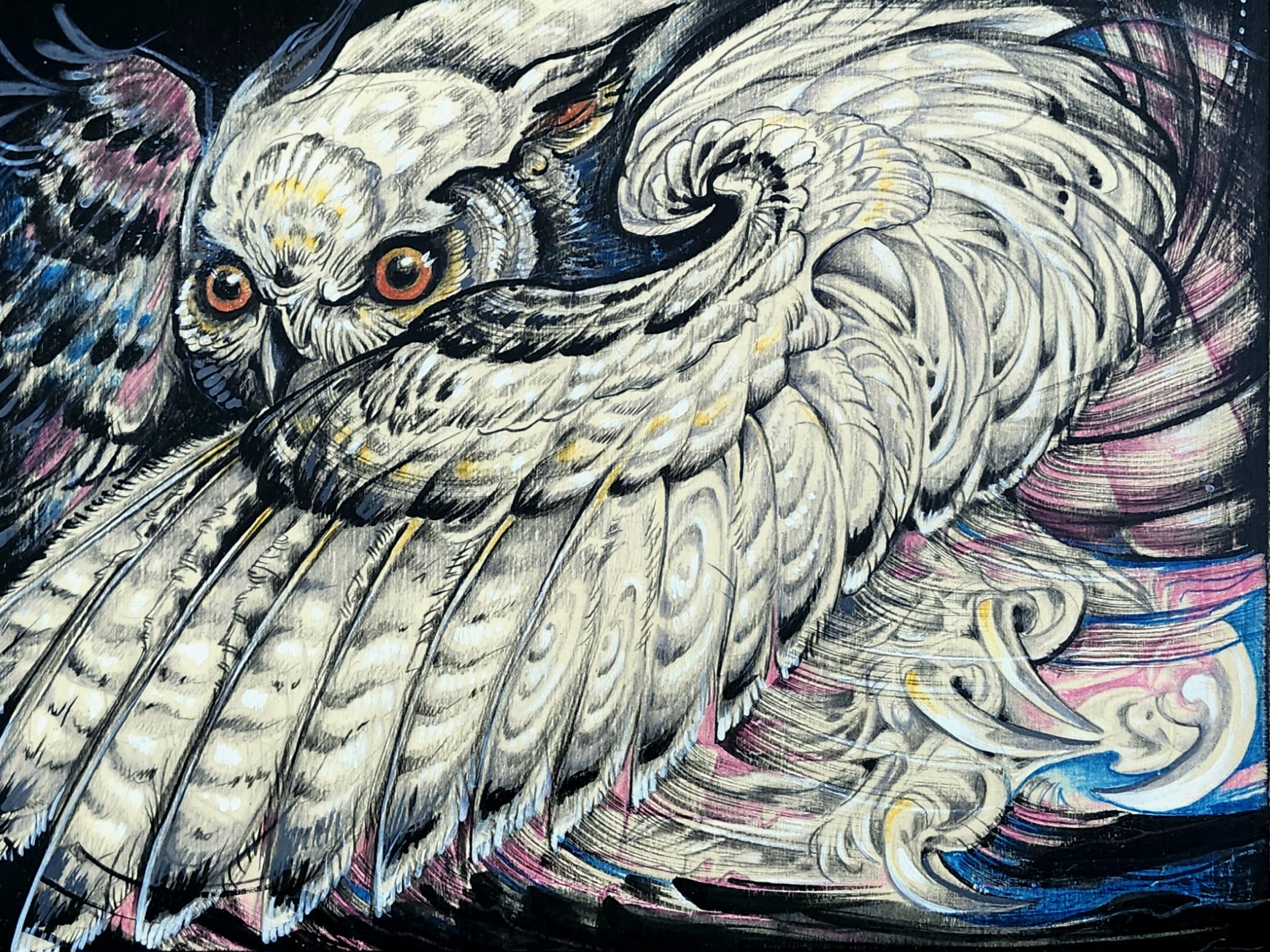
 Owl Phase
acrylic and color pencil on 9 x 12 wood panel
There are many birds to sing praises for. The common flicker with their flash of bright flaming colors; the sage grouse for its epic ancient ritual dance; the hummingbird for its speed and stunning displays of small ferocity. Out of all the avian species, owls are the ones I have the most frequent and unique encounters with. I try not to determine any particular language for it other than wild chance, from chasing a gut feeling, the kind that brings me to the right places at the right time. I have been head-swooped by a great-horned owl out in the hills of Ten Sleep, Wyoming. A great gray owl rolled over my windshield when traveling between Ten Sleep and Worland late on a moonlit night. I have walked up on nests and fledglings, been crooned by the dueling serenades of mated pairs, and seen them frequently in my dreams. There can be a variety of interpretations for those reasons. I do not waste my time on internet searches or quick-fix citations that glean their information on superficial appropriations. Those relationships are long, complex and distinct to their persons and their cultures. What I have come to know has been an embodiment of my own feeling and my own deeper sense for these specific moments in time as well as the parallels between what we continuously learn about owls. I am a young relative to this ancient predator, comparatively, and a student to its archaic wisdoms, at best. What can be determined as inherent wisdom with the owl, for example, should be associated with the great span that they have appeared in oral story, in stone art, and in our own fossil records. The oldest known owl fossils, like the Ogygoptnyx wetmorei, are dated as far back as the Paleocene epoch, roughly 60.2 to 56.8 million years ago. They are found all over the world. Imagine the intelligence that such a being could carry down that kind of lineage. The type of knowledge that exists in the subtle realms, outside of human language and interpretation, born in the nocturnal spaces of hunting, of engineering feathers that are shaped with teeth to distribute the air currents just enough to keep them silent in their pursuits of prey, with the right internal gear to navigate complicated routes. Recently, studies have been published documenting the pigments in owl feathers called porphyrins that signal fluorescence brilliance under ultraviolet light. Imagine, still, what this might appear like to other animals who can detect these sensitive spectrums. What does an owl look like to a mouse? Perhaps invisible. Perhaps like a psychedelic entity. To me, this illustrates a magnitude of depth that we only barely scratch the surface of. To that depth, I pledge my allegiance: what a farce to diminish any thing as less than what it really is. To the shadows, I shine my subtle light: that is where the truths reside, all the knowledge that many have tried to hide.